about me

I'm an Irish guy living in France. I like music, books, creative writing, art, history, vegetarianism, people, and chocolate.

blog roll

Why not check out these links?


Search

Sunday 4 January 2009

Duct Tape Christ


Yesterday we went to Paris to meet up with friends we hadn't seen for a while, and we decided to go to the National Museum of Modern Art in the Centre Georges Pompidou. I didn't really know what to expect because I know very little about 20th century art. I was afraid of it being very arrogant, filled with paintings that any three-year old could make and which are only considered art because their creators are famous. There was some of that, but not too much, and I actually really enjoyed our visit.

There was an exhibition of works by Jacques Villeglé, a French artist I'd never heard of, who has been making pictures out of lacerated and ripped posters he found on walls in French cities since the 1950s : political posters, adverstisement posters and band posters. To quote the museum's website, "Villeglé's work is a tremendous seismograph of our "collective realities" such as they are distilled by urban space and whose stories are recreated for us via the unusual reality of its walls. It reveals to what extent what we see is conditioned by this everyday visual environment and reactivates our memory in a critical, but also enjoyable, way."
Villeglé is also famous for his "alphabet socio-politique" in which he uses political and religious symbols. The exhibition was fascinating, and would definitely be very interesting for semioticians.

There was also an exhibition about futurism. I didn't know much about the movement, but one of our friends has studied it during the year so she was able to explain quite a bit. The futurists focussed on machines, speed and the industrial world, and believed that technology would change the world for good. Unsuprisingly, a lot of them were fascists. I didn't really like the paintings, but they revealed the way in which the futurists perceived the world at that time, which was very interesting. With today's environmental crisis it's hard to understand how naïve they could be about technology.

Finally we visited the main gallery. Some of the more contemporary works were very pretentious (a white canvas with a line or two brushed across : it might have been original 30 years ago but it's a bit cliché now. Time to move on?). But they were some really thought-provoking works. One was a video : an artist went to Yemen to film kids carrying placards he had made and on which were written in arabic the names of famous Western "heroes" (Minnie Mouse, Picasso, Zorro, Santa Claus, James Bond...) to show how capitalism finds a way into poor societies and undermines centuries of local tradition and culture.

Another interesting work was a red and white duct-taped crucifix. Unfortunately I can't remember the name of the artist, but she or he was South African, and wanted to represent the way religion is used to justify the most terrible things. I think it's a very powerful work, and it could be applied to the situation in Northern Ireland or the way God was used to justify the war in Iraq.


I'll finish by posting a picture of the Parisian skyline. The view at the top of the Pompidou centre is breath-taking. When you see Paris from the top, you understand why so many people think it's one of the most beautiful cities in the world.


Saturday 3 January 2009

Camera Obscura


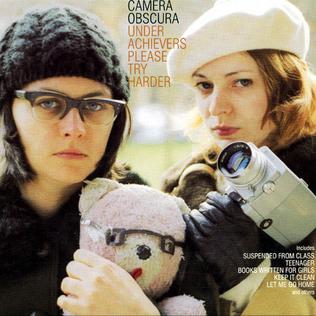
During the summer I listened to a lot of Nick Drake, but the band that most punctuated my year was, without a doubt, Belle & Sebastian. But for the past few months there's been another band competing for my attention : Camera Obscura. I heard one of their songs, I Love My Jean, as I was listening to one of Deezer's radios one day, and for a while I thought I was listening to an early B&S song. Wikipedia promptly informed me that Camera Obscura is an indie pop band from... Glascow. Just like Belle. I also read on some music blog that Stuart Murdoch helped produce their first album, Biggest Bluest Hi Fi (2001) but I'm not sure if that's true or not. But despite this connection, Camera Obscura don't sound merely like a Belle & Sebastian cover band.
Biggest Bluest Hi Fi is the album I like best so far, but they've issued two other good ones since (Underachievers Please Try Harder, 2003, and Let's Get Out Of This Country, 2006), as well as a number of singles (including a "cover" of Robert Burn's song,A red, red rose).
I'll be keeping an eye on this terrific wee band during 2009...

Sunday 16 November 2008

Books

I was just browsing Youtube videos and found this short stop-motion, which I thought was very sweet and cleverly-done. Bravo to Molly Green for making it.


Saturday 15 November 2008

Pink Elephants


Here in Reims, the Socialist Congress is currently taking place. It is part of a process during which members of the French Parti Socialiste have to agree on a new party secretary. This is a tricky task as they need someone popular enough to unite the whole Party. During a preliminary vote, Ségolène Royal, failed candidate of the last presidential election, came out with the highest number of votes — but only by a small margin. She is reasonably popular in France, but she is rather pro-free market and authoritarian, more a social democrat than a socialist. In fact, some believe that if she had become president, the only thing which would have been different from Sarkozy would have been the rhetoric. Which is probably true. But several big names in the Socialist Party are uniting against her : several candidates continue to fight for the leadership. When members of the Socialist Party actually manage to secure positions of power in their party, they stay there. Forever. (Because of this the French media nicknames them "the elephants"). And that's the major problem with the French Socialist Party. They spend so much time bickering that they don't concentrate on opposing the government — not in a responsible, constructive way. Which means that many left-leaning French people are sick of the party.

What are the alternatives? The Communist Party, which abandoned the dictatorship of the proletariat several years ago, is what the French Socialist Party was a few decades ago : truely Socialist and reformist. But their popularity hit an all-time low during the 2002 elections and they never quite recovered. Perhaps it's because they are perceived as not being very young and dynamic.
A truely popular figure among French leftists is Olivier Besancenot, a trotskyist postman and leader of the Revolutionary Communist League. He was one of the candidates for the French presidency last year and I went to see him speak one evening when he was in Reims. He was small, dressed in jeans and a jumper, without a tie, but he was the most charismatic of all the candidates. Man, he knew how to talk. He is known for his speeches —he never uses any notes, he just memorises them entirely or makes it up as he goes along! He is especially popular among young people, because of his youth and passion. I like many of his ideas, but frankly, they are really very utopian. But what really bothers me, however, is the fact that his party hasn't given up the idea of dictatorship of the proletariat and revolutionary struggle. Even if they never put it into practise, it's still in their manifesto, and I can't condone any party or politician who sees violence as a solution.
On the same line, there's the trotskyist Lutte Ouvrière ("Worker's Struggle") a party whose leader Arlette Laguillers is a running joke, partly because she's been steadily leading the party since the 1970s. She's a friendly wee granny now, but it's harder to pull off being a revolutionary at that age. And besides, the party has the reputation of working a bit like a cult or a Masonic lodge, because of its watertight hierarchy system.
That leaves no other real party to oppose capitalism and Sarkozy's increasingly thatcherist-gaullist politics. Well, there's the Greens, which I have a soft spot for, but they're not "watermelon" enough for me : plenty of green, but not enough red. It's hard to see to which extent they care about the people. They have a reputation of being a party for upper-middle-class bohemians...

It's hard not to be left disappointed by the Left.

What France needs is not so much a party as a movement, grassroots if possible, a sort of united popular front which would bring a viable alternative to capitalism. The French are good at protesting. Well, that's a first step, and "bravo" for that. But opposing is not enough. Creating, imagining, building and offering alternatives is the only way forward if the Left doesn't want to be left in the sidelines.

Thursday 13 November 2008

Anarchism : the next scapegoat?


Last week the SNCF (French national railway company) complained about several acts of sabotage which took place on its railway network. None of them put anyone's life in danger, and they apparently weren't done with the aim of derailing trains, but they had the potential of causing a lot of damage.
Just a day or two after the news hit the headlines, the French government anounced that they had already arrested a number of "suspected terrorists" : a group of "ultra-leftist autonomist anarchists".
What struck me (and a lot of French people) was that the government seemed to have moved very quickly... too quickly? Suspiciously quickly, at any rate.
Now all the newspapers are talking of the anarchist movement as if it's the next big terrorist threat. The people who were arrested were residents of an anarchist commune towards the South of France. According to Le Monde (the only newspaper which seems to have been unbiased in its coverage of the incident), there is absolutely no material evidence that they are in any way linked to the acts of sabotage. Which means that they are being detained only because of their political beliefs, under legislation which allows suspected terrorists to be detained up to four days without seeing a lawyer.
What really angered me is that Libération, which is supposed to be a centre-left newspaper, used the government's own terminology ("autonomist-anarchist movement") indiscriminately, tarring all anarchists with the same brush... as if anarchism was a single, monolithic movement, and a violent one at that. There is anarcho-syndicalism, pacifist anarchism, green anarchism, anarcho-capitalism, christian anarchism, anarcha-feminism... the list goes on and on. Lumping all those different ideologies and belief systems together is very unwise, and intellectually dishonest.
France has quite a strong leftist heritage, but not of a libertarian socialist kind... More of an authoritarian, statist type of leftism. The state is very centralised here, and it has been very strong for centuries : France has never had a strong parliamentarian tradition like in the UK or Germany. So I suppose that any ideology which attacks centralisation of power and a strong state is under threat of being targeted. And Sarkozy, although he is by no means a socialist, is firmly statist. Historians say he wields more power in France than Charles de Gaulle did back in the 1950s-1960s...
Is anarchism going to be France's next scapegoat? Only time will tell.

Monday 10 November 2008

Famine


Famine by Liam O'Flaherty follows a family of pratie farmers, the Kilmartins, as they face the potato blight, hunger, disease, the risk of eviction and British oppression in the Black Valley in County Kerry. The book is great in communicating what it must have felt like to struggle for life during the Great Irish famine of 1845-1849, and helps the reader understand why the trauma is so firmly engraved in the Irish psyche.
Liam O'Flaherty was a communist, and this is reflected in the novel, in which religious identity appears less important than class in defining dominant-dominated relationships. However O'Flaherty was no pacifist and this comes across very clearly, as he glorifies martyrdom, revolution and spreading blood for one's class and country. This talk of violence may seem naïve, misguided or even sinister to us today, but the book dates back to 1937, at a time when Ireland was a very young republic and was relying heavily on its set of Republican symbolism and myths to consolidate itself. But the novel does help give an idea of the suffering the Irish people went through during the Famine, which caused several of them to turn to violent revolutionary struggle.
The book is still relevant today as it deals with several issues that many people have to struggle with : identity, oppression, religious hypocrisy, violence/peace, and emigration.

There's No One as Irish as Obama...

Emerald Champagne


Emerald Champagne

rambling on...

Theme Modified by me and licenced under MIT License

Your Blog Title | feed

5ThirtyOne and Blogger Templates design | Top