about me

I'm an Irish guy living in France. I like music, books, creative writing, art, history, vegetarianism, people, and chocolate.

blog roll

Why not check out these links?


Search

Thursday 25 September 2008

The Jungle


I finished Upton Sinclair's The Jungle just a few days ago. It's about a family of Lithuanians that has immigrated to the USA in the early 1900s, lured by the American Dream's promises of wealth and happiness, only to end up working in the infamous factories of the Beef Trust in "Packingtown", Chicago.

I was looking forward to the novel as I expected it to be a bit like Steinbeck's Grapes of Wrath : both authors were investigative journalists and Socialists. Unfortunately Sinclair isn't as skilled a novelist as Steinbeck is : his characters are rather flat, so when the book's working-class hero,
Jurgis Rudkus, loses everything, it doesn't move you as much as when Tom Joad sees his family disintegrate. The plot isn't very solid, but it serves the author's purpose : to expose the gritty reality of life for the American underclass. And it's shocking : some of the things Sinclair describes are so horrible that he couldn't have made them up. He saw them during his investigations.

His muckraking novel shocked the nation, but not in the way Sinclair hoped for. Instead of striving to improve working people's conditions, all that the readers cared for were the parts in the books which dealt with the terrible lack of hygiene in the meat factories. (The public outcry actually led to a Pure Food Act).
"I aimed at the public's heart, and by accident I hit it in the stomach", Sinclair lamented.

But what interested me the most about the Jungle was the fact that it's a Socialist book, written by a dedicated Socialist in 1906, just a decade before the Russian Revolution. It's a socialism that hasn't yet discovered the excesses it would lead to under Soviet rule, and yet you can already detect some of the seeds of this future state-socialism. For example, the ''people" are always referred to in a very paternalistic, patronising manner.
Yet Sinclair isn't completely utopian either; he very honestly states that Socialism won't solve all of the world's problems, that there will still be conflict, but he argues that it would be a better alternative to capitalism.

In the last chapters, once Jurgis has seen the light (Socialism is clearly described as a new "dispensation", a new "revelation"), he witnesses several discussions between Socialists with very different ideas : for example a debate about religion between a Swedish professor and anarchist and an American ex-minister. The latter argues,
in Tolstoyan fashion, that Christianity has been distorted by the institutional church and that Christ's message of peace, love and social justice has been forgotten. (It is worth noting that Upton Sinclair was himself some sort of a Christian socialist.) Something which was true in Sinclair's time, and which is equally true in Western christianity today, where the Church-body has become the church-institution, where spiritual and material salvation are seperated and where man-made rules become more important than compassion and love.

I'll finish with a quotation from the novel. Referring to a bunch of rich christians trying to evangelise the starving poor, the narrator exclaims:


"They were trying to save their souls- and who but a fool could fail to see that all that was the matter with their souls was that they had not been able to get a decent existence for their bodies?
"

Sunday 24 August 2008

Holidays...

I won't be posting for a while, as we're leaving in a few days to go on holidays for a couple of weeks. See you soon. =)

Wednesday 20 August 2008

A Really Inconvenient Truth

A Really Inconvenient Truth is an analysis of Al Gore's An Inconvenient Truth and a critique of capitalism by American eco-socialist Joel Kovel, who ran against Ralph Nader for the Green Party's Presidential nomination in 2000 .
If you're a hardened capitalist, you'll probably hate this video. Otherwise you should have a look.


The main point Kovel makes is that you can't try to stop environmental crisis and the thrashing of our planet without challenging the capitalist system, and all that it entails.
I really appreciated the fact that Kovel makes it clear that we, as individuals, have to change our lifestyle of unabashed consumerism. Too many socialists are busy attacking capitalism (which is a good thing in itself) but aren't ready to change any of their own habits.

Tuesday 19 August 2008

Horse before the week ends


I've just received the strangest phone call ever.


Phone rings.
"Allô?"
"This is (so-and-so), do you need horse before the end of the week?"
"Huh... Sorry? And you are...?"
"This is (so-and-so). Do you need horse before the end of the week?"
"Horse?"
"Yes, don't you need any?"
"I... think you've got the wrong number."
"Is this not (some phone number)?"
"Nope."
"Oh, sorry sir. Bye!"

Hope she finds the right number or some unlucky person will not be getting horse before the end of the week. Whatever that means.

Saturday 16 August 2008

Let the Good Times Roll

A good friend of ours, Donna, stayed at our place for four nights. She lives in the Netherlands now and we hadn't seen her for almost a year, so it was great to spend time with her again. We really enjoyed the fellowship ("yea the fellowship!") and spent a lot of time talking, often till the wee hours of the morn, catching up orelse re-dreaming the world. Other highlights included getting in the champagne cellars (where L works) and sampling the wine free of charge, a disco night, beer, watching the Omen (1976), going to cafés, complaining about society, beer, introducing Donna to (our version of) tecktonik dance and more beer.

Tuesday 12 August 2008

Amusing Ourselves to Death


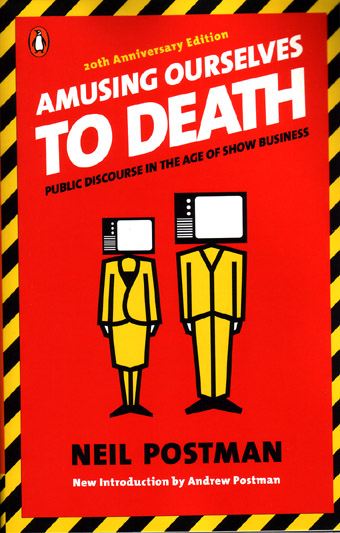
Amusing Ourselves to Death : Public Discourse in the Age of Show Business is an enlightening book, and is an easy read. It was written over twenty years ago, back in 1985, but it's even more relevant now than it was then.
Its author, media theorist Neil Postman, is now dead, but Penguin published a 20th anniversary edition of the book, with a preface by Postman's son.

Postman argued that the change from the Age of Typography (the printed word) to the Age of Television has not only had a huge impact on Western culture, it has changed how we approach the issue of knowledge (epistemology). The written word can convey statements that can be either accepted as true or refuted, but images don't offer that possibility : they can ony be looked at.
The author illustrates this with the example of advertising : in the mid 19th century, advertisements in newspapers were paragraphs of rational discourse which gave information about the product. On 20th century TV advertising (and even more so on 21st TV as well as online advertising), slogans, jingles, music, pictures and videos are used, and there is no true description of the product itself : what is important is that it looks good on the silver screen. The actors are there not to give ant new insight about what they're presenting, but because they have pretty faces and look perfectly happy : implicitly promising the viewer that to reach a state of beatitude, all you need is to buy the latest car, or ipod, or chocolate bar.

If things stopped there, it would be bad enough. But it gets worse. Politics and democracy are threatened by television. To quote Postman, "we may have reached the point where cosmetics has replaced ideology as the field of expertise over which a politician must have competent control". In other words, images speak louder than words. It doesn't matter what a politician thinks about climate change or social justice or immigration, what really matters (to the viewer at least) is how good the politician looks on TV, how he speaks, how he dresses, where he goes on holiday, how pretty his wife and children are and so on. This was already the case in '85 when the book was written ; it has become the same in France with Sarkozy, the King of Bling, and his groupie wife Carla Bruni (who advertises for her husband through her music albums, among other sings). If we've begun to chose our rulers because they look good on the telly, that is a very scary fact. Hitler looked good in uniform.

To conclude, there is also an interesting chapter on religion and its relationship with TV : with the likes of televangelism. I'm not going to go into the details, but basically, the author argues that even if isn't the intention of TV preachers (though I may suggest that often it is), the fact of turning a religious service into a show and more significantly the fact of turning themselves into performers is, ironically, a form of blasphemy : the preacher is glorified, not the deity.

The book is really worth the read. And it needn't make you feel guilty about watching the telly : the author himself argues that the only harmless TV is "rubbish" TV. TV is okay as long as it sticks to mindless entertainment. It becomes dangerous when it starts dealing with serious issues... as it inevitably turns them into a form of entertainment.

Thursday 31 July 2008

Eagle vs Shark


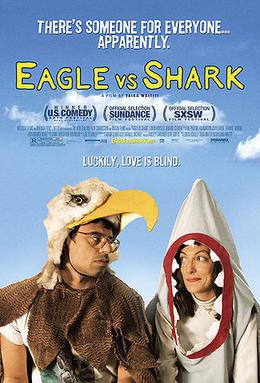
I enjoyed watching Eagle vs Shark a few days ago. It's a kiwi rom com featuring Jemaine Clement (Flight of the Conchords), with a quirky, offbeat feel to it, in many ways comparable to Napoleon Dynamite : it has nunchucks, weird animal drawings, and strange dialogue.
The soundtrack is great, most of the tracks are by New Zealand indie band the Phoenix Foundation.

If you want to check it out, you'll find the link at the bottom of this post, but hurry! Movies uploaded to Youtube usually don't last long these days.

Emerald Champagne


Emerald Champagne

rambling on...

Theme Modified by me and licenced under MIT License

Your Blog Title | feed

5ThirtyOne and Blogger Templates design | Top