about me

I'm an Irish guy living in France. I like music, books, creative writing, art, history, vegetarianism, people, and chocolate.

blog roll

Why not check out these links?


Search

Saturday 1 August 2009

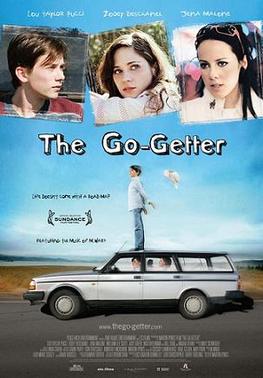
The Go-Getter

I'd never heard of the Go-Getter until I checked out Zooey Deschanel's filmography ; it's an indie road movie which was released in the beginning of 2007 and only ran for three days, grossing less than $12,000. Most of the cast (which is quite small), I'd never heard of before. Apart from Zooey Deschanel, the only recognisable face was Jena Malone (Donnie Darko, Into the Wild).
I loved the movie. I mentioned this in one of my last posts, but I'm a sucker for those kind of "indie" films. All the ingredients were there : an introspective anti-hero, a couple quirky characters, understated acting, the classic road movie "drive-by" scenes, and of course the trademark indie folk music (M. Ward, Animal Collective, Elliot Smith, the Black Keys).
Unoriginal, probably. Clichéd, no doubt. But it does the trick.


It's funny how different people respond so differently to works of art, be it painting, movies, music or literature. I don't think it's only to do with upbringing or education or peer influence. I can't help thinking that it has a huge deal to do with personality. I know it has its limits, but I think personality psychology could provide some answers, or at least some clues. (I've been interested in the Myers-Briggs Type Indicator and the "Enneagram" theories lately.) For example, I wonder if certain types prefer to watch (or to work on) certain films. Maybe SP types ("Artisans") prefer quicker-paced, action and sometimes violence-orientated) movies ; and NFs ("Idealists") maybe opt for slower, more introspective films.


Thursday 30 July 2009

Melomania

Got back from Scotland about a week ago, but I'm already back at work, preparing for the upcoming year. I might put some pics up later.
In the meantime, here's what I've been getting my kicks from (apart from shrooms, of course).


Wilco - Wilco


Eels - Hombre Lobo


The Hold Steady - Stay Positive


Kaleidoscope - Faintly Blowing


Crosby, Still, Nash & Young - Déjà Vu

Monday 29 June 2009

Sunshine Cleaning

I went to see Sunshine Cleaning yesterday ; I hadn't been to the cinema for a while. I'd missed it. It's so different from watching DVDs. I don't know if it's because of the "collective experience" side to it, or the bright silver screen, or the dusty tattered old seats, but there's definitely something magic to the cinema... A bit like in Terry Pratchett's Moving Pictures. The cinema I go to in Reims is privately owned ; it's set in an old opera-house, and it often shows "indie" films and foreign movies, subtitled and in the original language instead of dubbed as in most French cinemas.

I was really looking forward to Sunshine Cleaning. I'm a sucker for all those Sundance festival films. I'm aware that that type of "indie" film isn't original anymore. The humour is often dark, the characters are offbeat, and the soundtrack is always made up of indie pop or folk bands. But I love those films. I go to the cinema for the entertainment, not for highbrow pseudo-intellectual arroganza—I spend enough time reading that sort of stuff for uni, thank you very much. The Sundance films maybe aren't original, but they're entertaining, and more often than not, refreshing.

In Sunshine Cleaning, as in Little Miss Sunshine, all the characters are "broken", they are all "losers". Rose (Amy Adam) is an ex-cheerleader who is now a cleaner-lady, who hasn't the strength to put an end to an affair with her high school sweetheart who decided to marry another girl. Rose's little boy, Oscar, is a gifted but "special needs" child who keeps getting kicked out of school because of his OCD behaviour. Rose's younger sister, Norah (Emily Blunt), is a thrill-seeking immature young adult who can't hold a job, and tries to drown her grief in anything she can. The girls' mother committed suicide when they were very young, and they've never managed to get over it ; their father (Alan Arkin) keeps making promises he never keeps, and, convinced that he has "business acumen", constantly plans new and unsuccessful business ventures. All the characters need redemption, and they find it by helping others. Rose and Norah feel a special connection to the people they clean up after (they start a crime scene cleanup business). Their father takes care of Oscar while they're at work. A one-armed shopkeeper looks after Oscar at one stage during the film. And yet all these "helpers" are never "rewarded" in any obvious way. Rose takes care of the whole immature bunch (son, sister and father) and never gets any recognition for it. The one-armed shopkeeper who seems to like Rose doesn't even get a "thank you" from her for looking after her son. Norah tries to help a young woman by reconciling her with her dead mother, and it doesn't work out ; she even accidentally burns down a house while working alone to let Rose go to a high scool reunion party. The grandfather fails to raise enough money to buy Oscar a gift he promised to give him for his birthday.
None of the characters are "rewarded" in any conventional way. Instead, they find love. Not eros, not romantic love, but agape, unconditional love. They grow closer to one another. They may be broken, and yes, they may be losers in the eyes of the world, but together, they are able to "cope", to live, to find joy.


Monday 22 June 2009

Burqa or no burqa?


There is a huge debate going on in France at the moment over the burqa, the Islamic headdress which covers women from head to toe, and which conceals the face behind a mesh screen. Should it be banned by the state, or not ?

On one side there's the majority of French people who, in the name of freedom, women's rights and laïcité (the strict separation between religion and the state) argue that the burqa should be banned in public places.
On the other there are a number of Muslims—mostly the women who wear the burqa themselves—who claim that they are exercising their freedom by choosing to wear this garment and that any legislation banning it would be an infringement on their right to practise their religion.
What is interesting is that it has emerged that most of the burqa-wearers are in fact French converts to Islam ; not immigrant Muslims or second-generation "immigrants". In fact several moderate Muslims have argued against its use.
In an important speech in front of parliament this afternoon, Sarkozy proclaimed his opposition to the wearing of the burqa and anounced that he would set up a committee to decide which measures—if any—should be taken to deal with it.

I believe that the burqa is one of the biggest (and worst) symbols of the oppression of women ; of course extremist Islam does not hold a monopoly on the ill-treatment of women, but that's no excuse. Advocates of the burqa have said that it protects women and "liberates" them by preventing men from seeing them as objects. Yet it seems to me that wearing such a garment is just as dehumanising as selling one's body by working as a porn actor or as a prostitute. Just as sex workers and women in the porn industry are exploited—consciously or not—so it is with the wearers of the burqa. And even if some women wear the burqa willingly, by choice, who is to say how many are brain-washed, frightened or even coerced into wearing it? I don't think it's a sign of "cultural imperialism" or Western arrogance to be against the wearing of the burqa. I don't mind the wearing of the hijab (the "headscarf"). It's not something I agree with but I can understand it. But the burqa? That's simply going too far.

Yet, having said that, I'm not sure that banning the burqa is such a good idea. Perhaps for minors, but not for adults. For one thing, on a pragmatic level, I don't think it's a very good strategy. It would almost certainly further alienate the Muslim community. It could foster a siege mentality, and push even more young men and women into the arms of the wahhabists. Besides, if the government wants to fight the rise of religious extremism, it should work hard at addressing one of the root causes of this radicalisation : poverty, ghettoisation and feelings of alienation because of the fact that our consumerist society has only the latest Ipod to offer as an answer to life's questions.
But I'm also not in favour of the ban for another reason : I believe that too much legislating isn't a good thing ; I don't like the idea of a bureaucratic state encroaching on individual freedoms. It isn't its business. I don't have any answers to the problem, but I don't think that creating more laws is the solution.

Wednesday 17 June 2009

Sorry I'm Late

I haven't much time to blog these days, but I'll try to get back to it soon... In the meantime here's another cool stop-motion video by Tomas Mankovsky.


Wednesday 13 May 2009

Stories


Stories. That's one thing I couldn't do without. Like music, wine and chocolate.
In fact, it's probably something noone can do without. Stories are everywhere. In the films we see at the cinema, in the soaps we watch on the telly. The best songs are stories put to music—or music put to a story. Paintings often bring stories to life. Why is Mona Lisa smiling ? What happened to Van Gogh's ear ? What was Piet Mondrian trying to put in order, with his rigid perpendicular lines and sober squares ?

Advertisers are aware of our interest in stories. Brands like to pretend that they are several decades or even several centuries old, and often on the packages of their products you can read their "story". One of the most important trends in clothing and decorating is the "vintage look": clothes and objects have to tell a story or at least have a hi
story.

Oral storytelling is probably as old as humanity itself, and every culture's mythologies are based on stories—more so than theology. History is boring when it's presented as a list of dates, intriguing when it tells the
story of the people that lived ten, a hundred, a thousand years ago. Philosophy, religion and science become dogmatic when they concentrate on the particulars and forget the story.

Heck, we all like to have some amount of drama going in our own,
real lives ; we all want to have a story to tell.

It was my grandfather who first introduced me to the world of stories. I remember him sitting in his old dark green armchair, resting his hands on his generous belly. I would sit facing him, on the sofa, my toes barely touching the floor, looking out of the window at the semi-detached red brick houses which surrounded the street. The only way you could tell them apart was by looking at the drain pipes, which hugged the walls like ivy: they were all painted in different colours. Brown, blue, green, yellow, white, red. Granny would come in to the living room, bringing me a cup of fresh milk and a plate with a buttered scone or a jam bun. Grampa would only get a cup of tea. He would give Granny a sad puppy dog look, but she would never yield. He, however, would always get a bar of chocolate or a biscuit from somewhere—he must have had a hidden stash. He would give me one, take a bite of his an say: "Well-now." Then his story would begin. About musketeers, with their swords, capes, and moustaches. About pirates, with their eye-patches, parrots, and panache. He would tell me about James Bond—his gadgets, his girls, his martini—when I was still too young to be allowed to watch the films. Sometimes he would tell me one of his own stories: as a boy scout he had slept in a haunted castle and heard the banshee scream ; he had come across the terrible pooka-horse when cycling down the small Irish country roads as a young man, and it had made him ride into a dung hill in a field ; he had seen a faerie in the isle of Man and had caught a glimpse of a leprechaun in his own garden.
Grampa's stories sent be back in forth in time, they took me all over the world. They taught me how to daydream, how to fantasise, how to develop a rich inner life. They set my head firmly in the clouds. I've never come down since.

Sunday 3 May 2009

Tree


He stood barefoot, his back against the old oak tree. He closed his eyes. He dug his toes into the rich, welcoming earth which lay between the oak tree’s gnarly roots. They were warm in the primeval dust which had swallowed them up. He almost felt them grow, reach down deeper, further, closer to the timeless, abyssal mysteries. He slowly lifted his arms above his head. He could hear the suave whispering of the leaves above him. The wind, that evanescent lover, stroked his hair, caressed his soul. His face glowed in the sun. He could feel its fingertips on his cheeks. He smiled. He knew at that moment that he was alone, utterly, fatally alone. But he was alive. And that was enough.


.

Emerald Champagne


Emerald Champagne

rambling on...

Theme Modified by me and licenced under MIT License

Your Blog Title | feed

5ThirtyOne and Blogger Templates design | Top